The Most Expensive Moment in Preconstruction Is the One You Don't See Coming
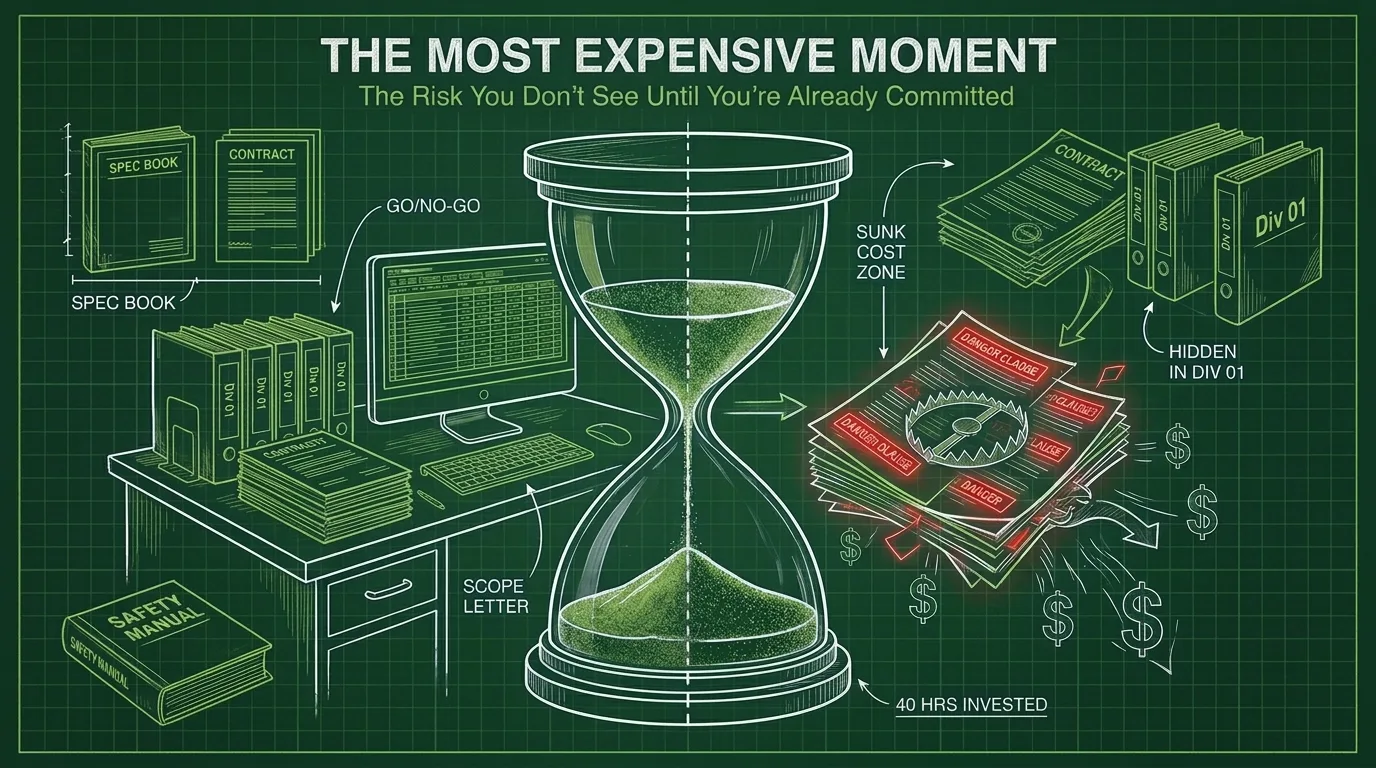
There's a moment in every bid where everything changes. Not when you win the job. Not when you break ground. Earlier than that.
It's the moment you've invested 40 hours of estimating time into a project — and then you find the clause that should have killed it at go/no-go.
I've watched this happen for years. We've processed over $20 billion in bids at RhinoDox, and the pattern is always the same: the risk that costs the most money is the one that shows up after the team is already committed.
A 38-year construction industry veteran put it best: legal surfaces "never sign" clauses deep into pursuit, when executives are already emotionally committed. At that point, you're not negotiating — you're talking yourself into accepting terms you'd never agree to on day one.
The Sunk Cost Trap
Here's what makes preconstruction different from every other phase of construction: it's the only phase where walking away is still free.
At go/no-go, the math is simple. You've spent an hour, maybe two. If the project has LDs you can't stomach, a PLA requirement you can't meet, or retention terms that'll wreck your cash flow — you walk. No harm done.
But after your estimating team has spent a week on it? After they've called subs, pulled material pricing, and built a scope letter? Now you're in the sunk cost trap. Every hour invested makes it harder to say no.
One of our research participants — a two-estimator shop — told us: "You can turn in a bid and not catch that there's a $50,000 allowance you're supposed to carry. Well, guess what? All of a sudden, that's $50,000 out of your profit."
That's not a hypothetical. That's a Tuesday.
Where the Money Hides
The obvious risks aren't the ones that kill you. Every experienced estimator knows to check for LDs, prevailing wage, and bonding requirements. Those are page-one items.
The expensive misses are buried deeper:
Non-scope cost drivers — testing requirements, safety staffing mandates, cleanup crew ratios, commissioning demands, temp heat, temp power. One of our beta customers told us these items cost "tens to hundreds of thousands" and they're routinely missed because they're buried in Div 01, not in the trade-specific sections where estimators spend their time.
Payment platform fees — Textura, GCPay, Procore, eBuilder. Six out of twelve people we interviewed flagged these. On smaller projects, the admin costs alone can erase profit.
Flow-down traps — That same industry veteran told us: "Subs often miss owner flow-downs. A three-sentence blurb buried in the exhibits binds them. Deadly if ignored." One of our users proactively sent us both his subcontract AND the GC-to-owner contract because he knew the trickle-down language would create obligations the sub agreement didn't spell out.
Cross-document conflicts — A construction attorney we work with told us about a $500K miss caused by conflicting fastener specifications between a project spec and a manufacturer installation guide. Nobody caught it because nobody reads both documents together.
The Real Problem Isn't Reading Speed
Every sub I talk to says some version of the same thing: "We don't have time to read everything."
But that's not quite right. The problem isn't reading speed. It's knowing what matters at each point in the bid.
At go/no-go, you need deal killers. Five things that change whether you pursue this job. You don't need a 10,000-page analysis.
During bid development, you need scope gaps, cost drivers, and cross-trade conflicts. The stuff that changes your number.
At pre-award, you need the contract terms that'll bite you after you sign — indemnity, notice windows, warranty extensions, pay-if-paid structures.
Same project. Same documents. Different questions at every phase. And different people need different answers — your estimator cares about different risks than your CFO.
We built something that understands that.
What Comes Next
Next, I'll talk about the Risk Octopus — the 8 categories of risk that live across every bid package — and why reading specs and contracts is only part of the picture.
Does this sound familiar? I'd love to hear your "we caught it too late" story. Reach out to me or Colin French (colin.french@rhinodox.com).
Justin Ullman is the Founder & CEO of RhinoDox. $20 billion in bids processed. In the trenches with subcontractors since 2020.