The Risk Octopus — Why Reading Specs and Contracts Is Only Half the Job
We're updating this post with some big additions. Check back April 9th.
Ask any estimator what they review before a bid and you'll hear the same answer: specs and contracts.
That's the right starting point. But it's not the whole picture. Not even close.
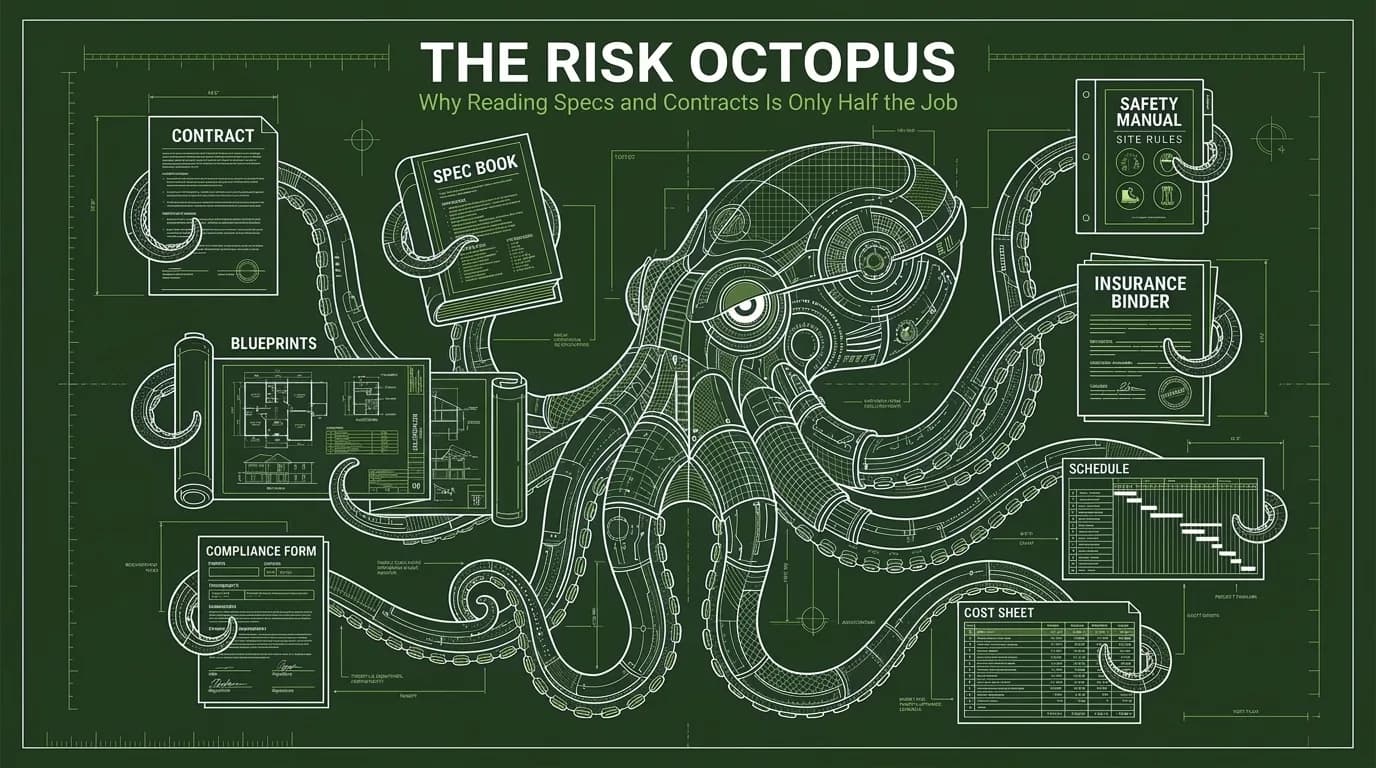
After processing $20 billion in bids and sitting through hundreds of preconstruction conversations, we've mapped what we call the Risk Octopus — 8 categories of risk whose arms reach into every corner of a bid package. Some live in specs. Some live in contracts. And some live in documents that most teams never open.
The Documents Nobody Reads Together
Here's the thing about construction risk: it doesn't stay in one document.
A spec might say one thing about material requirements in one section and something different in another. Nobody catches it because nobody reads both sections side by side — until the conflict shows up in the field.
An OCIP document spells out insurance requirements that override your standard coverage. A safety manual mandates staffing ratios that your estimator didn't price because they were in a document outside the spec book. Environmental compliance requirements buried in an appendix create disposal obligations nobody budgeted for.
These aren't edge cases. We hear these stories in every customer conversation.
The 8 Arms of the Octopus
We organized construction risk into 8 categories — what we call the Risk Octopus, because its arms reach into every corner of a bid package. When you're reviewing, you need to think across all of them:
Go/No-Go Determinants — The deal killers. PLAs, First Source hiring requirements, lien restrictions, bonding thresholds that exceed your capacity. These should surface in the first 10 minutes, before anyone starts estimating.
Commercial & Contract Risk — LDs, retention percentages, indemnity clauses, notice windows, pay-if-paid structures. A 38-year industry veteran told us: subs often miss owner flow-downs — "a three-sentence blurb binds them. Deadly if ignored."
Scope & Technical Risk — Scope gaps, cross-trade ambiguity, missing items. A construction attorney we work with estimates that 50%+ of all bid conflicts live here. The attic stock percentage that doesn't match between spec sections. The coordination drawing requirements that nobody scoped.
Cost Drivers — The margin killers. Testing, cleanup crew ratios, safety staffing, temp heat, temp power, mockup requirements, payment platform fees. One of our customers said it plainly: "These items cost tens to hundreds of thousands." They're buried in Div 01, not in the trade sections where estimators spend their time.
Compliance — Prevailing wage, MBE/DBE requirements, certified payroll. Miss these and you're not just losing money — you're losing eligibility for future work.
Schedule & Logistics — Phasing requirements, manpower restrictions, shutdown windows, weekend work mandates. These affect feasibility at go/no-go and manpower cost during bid development.
Project Type Risk — Sovereign nation projects, unusual jurisdictional constraints, government-specific clauses that don't exist in commercial work. Corps of Engineers specs play by different rules than a private developer's.
Stakeholder Risk — Who's involved in the project, and what does that mean for you? Owner flow-downs that change your obligations. GC requirements that don't match what the owner spec'd. The more parties in the chain, the more places risk hides between handoffs.
Why Nobody Catches Everything
It's not a competence problem. It's a math problem.
A typical bid package is hundreds — sometimes thousands — of pages across specs, contracts, drawings, addenda, safety manuals, insurance documents, and compliance requirements. An experienced estimator has maybe 4-8 hours to review it — and they're running five other bids at the same time.
So they triage. They go to the sections they know matter for their trade. They check the obvious deal killers. And they hope they don't miss the one buried in page 247 of a document they didn't have time to open.
Three out of four subs are already uploading specs to ChatGPT to try to solve this. They know what to look for. They just don't have time to find the answers manually across every document.
But ChatGPT doesn't know your bid phase or your role. It doesn't cite sources. And it treats every document the same way regardless of who's asking or when in the bid you're asking.
Building a Better Way
That's why we built LARRY. Not as another document reader — the world doesn't need another one of those. We built it as a preconstruction intelligence platform that reads across the entire Risk Octopus and tells you what actually matters for this bid, for your role, at this phase.
Every finding links back to the source document and page number. Because every one of the twelve people we interviewed said the same thing: "Don't tell me there's a risk — show me where it is in the document."
AI is not the answer. Understanding the problem is the answer. Then you apply AI.
If you're a specialty sub and you're tired of finding the expensive surprises too late — reach out.
Justin Ullman is the Founder & CEO of RhinoDox. $20 billion in bids processed. In the trenches with subcontractors every day.